
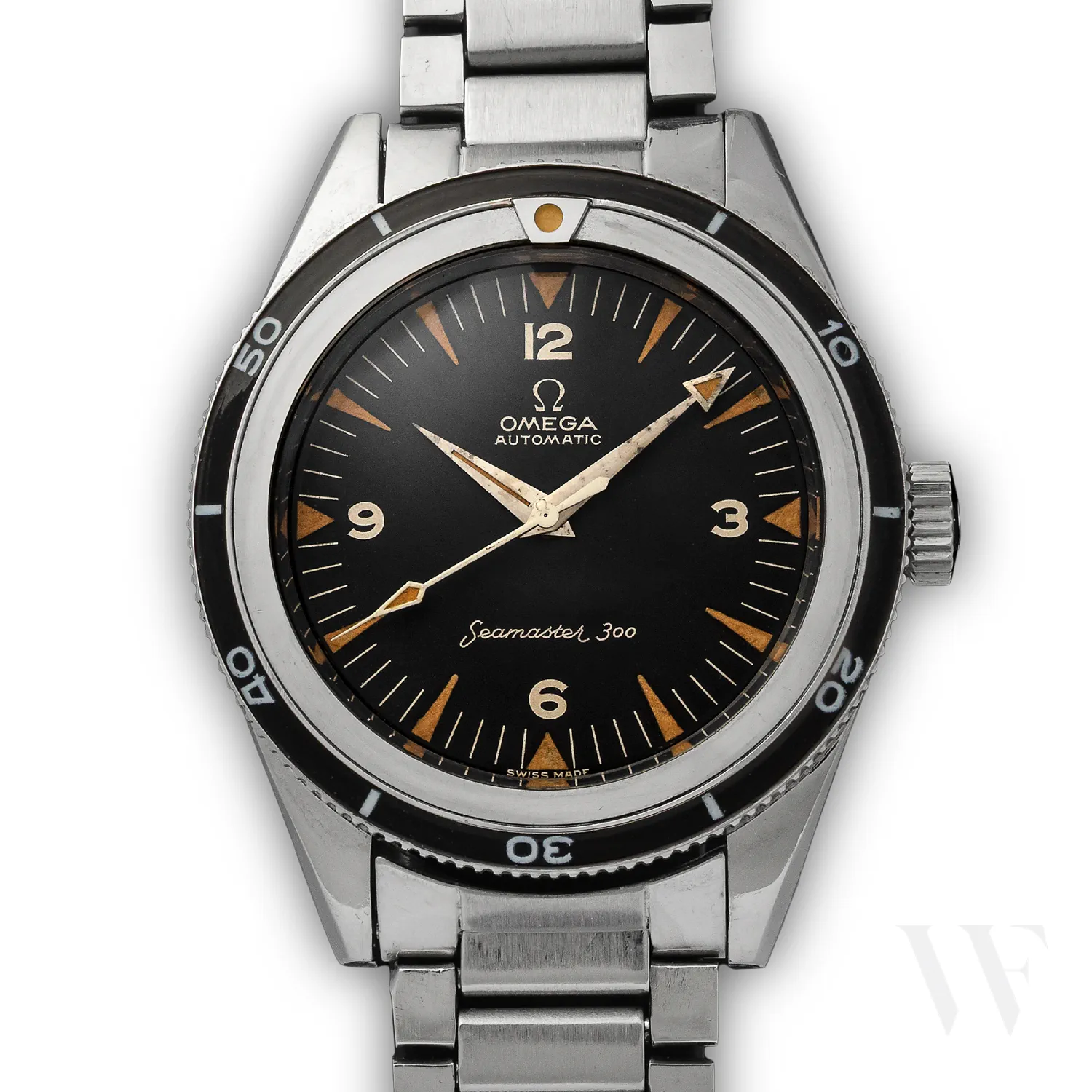
The present Seamaster 300 is a reference CK 14755-61 produced in 1963.
It features the late hand configuration (C3), distinguished by its drop-shaped seconds hand. Fitted with the correct reference 7912/6 bracelet, the watch is in excellent condition and all of its components are period correct. The dial and the bezel are in perfect condition.
A particularly attractive example of this iconic model, and increasingly difficult to find in such well-preserved condition.
Your privacy is important to us. This site uses technical cookies that are necessary for the correct functioning of the pages. With your consent, we and our selected partners also use profiling and tracking cookies (including third-party) for statistical purposes, to show you personalised advertising and to offer you social features. You can accept all cookies by clicking "Accept all", reject them while keeping only the necessary ones by clicking "Reject all", or customise your choices by clicking "Review preferences". By closing this banner via the "X" in the top right corner, you will continue browsing with only the default settings (technical cookies). You can revoke or change your consent at any time via the "Manage cookies" link in the website footer. For more information, please read our Cookie Policy .
Essential for the correct functioning of the site. They cannot be disabled.
| Cookie | Vendor | Duration | Purpose |
|---|---|---|---|
__stripe_mid |
Stripe | 1 year | Stripe anti-fraud security cookie to protect transactions. |
wp_consent_functional |
|||
wp_consent_statistics |
|||
wp_consent_statistics-anonymous |
|||
wp_consent_marketing |
|||
wp_consent_preferences |
|||
sbjs_migrations |
|||
sbjs_current_add |
|||
sbjs_first_add |
|||
sbjs_current |
|||
sbjs_first |
|||
timezone |
|||
woocommerce_items_in_cart |
WooCommerce | Session | Manages the shopping cart, session and security of WooCommerce. |
woocommerce_cart_hash |
WooCommerce | Session | Manages the shopping cart, session and security of WooCommerce. |
lccb_consent |
Let's Code Cookie Banner | 1 year | Stores the user's consent preferences (accepted or rejected cookie categories). |
sbjs_udata |
|||
sbjs_session |
They help us understand how visitors interact with the site by collecting information anonymously (e.g. Google Analytics).
| Cookie | Vendor | Duration | Purpose |
|---|---|---|---|
_ga_TF1R3XN8M5 |
Google Analytics 4 | 2 years | Used by Google Analytics 4 to persist the current session state. |
_ga |
Google Analytics | 2 years | Anonymously identifies users and sessions to calculate visit statistics. |
_ga_5TFS8M5TTY |
Google Analytics 4 | 2 years | Used by Google Analytics 4 to persist the current session state. |
Used to show personalised advertising and measure the effectiveness of campaigns. They may be set by third parties.
They store your choices (language, region) to offer you a personalised browsing experience.
| Cookie | Vendor | Duration | Purpose |
|---|---|---|---|
wp-settings-2 |
WordPress | 1 year | Stores personalised WordPress user interface preferences (e.g. layout, language). |
wp-settings-time-2 |
WordPress | 1 year | Records the timestamp of the last change to the user's WordPress settings. |
The present Seamaster 300 is a reference CK 14755-61 produced in 1963.
It features the late hand configuration (C3), distinguished by its drop-shaped seconds hand. Fitted with the correct reference 7912/6 bracelet, the watch is in excellent condition and all of its components are period correct. The dial and the bezel are in perfect condition.
A particularly attractive example of this iconic model, and increasingly difficult to find in such well-preserved condition.
In 1957, Omega introduced a trilogy of professional models: Speedmaster, Railmaster and Seamaster 300. The Seamaster 300 is a diver’s watch allowing a depth of at least 200 meters.
The first version, reference CK 2913, was produced from 1957 to 1961 and was succeeded by the CK 14755, which introduced the new calibre 552 — an evolution of the calibre 501 — featuring 24 jewels, a four-arm chamfered Glucydur balance, and a reduced overall height from 5.55 to 4.5 mm. This slimmer movement allowed for a lower-profile caseback, thereby reducing the overall thickness of the watch.
The “Small Arrow” hand configuration, introduced during the production of the CK 2913, was retained, with the minute hand ending in a triangular tip. Three types of seconds hands were used:
The referencing system was changed in 1962 and CK 14755 was renamed ST 165.014 and produced until 1967. In 1963, a new dial with bigger indexes was introduced, but that year also marked the birth of a new asymmetrical case line, to better integrate the crown: this is reference ST 165.024, produced until 1970/1971. In 1968, it was joined by a version with date (reference ST 166.024).
Although the Seamaster 300 was developed and marketed for a professional use (e.g. by COMEX or the British Army), its sharp and simple design, as well as its perfect dimensions / proportions (in particular reference ST 165.024) has attracted a much wider audience around the world and its popularity is still growing.
In 1848, Louis Brandt founded a company in La Chaux-de-Fonds which would become Omega. In the 1880s, the Louis Brandt & Fils company moved to its current site in Bienne and in 1894 the caliber Omega was created, which would give its name to the company. Renowned for its precise, innovative and affordable watches, it became the largest supplier of watches to the British Army during World War II. It also became the first company to time the Olympic Games in 1932. Among its range of numerous professional watches, the Speedmaster became the first watch worn on the moon in 1969.
The purpose of this document is to determine whether the constituent parts of the watch are conform to the model reference /period or not, and to value their condition and importance.
All the watches are provided with a digital certificate (the Watchfid-ID), that will be uploaded on your protected and anonymous digital wallet.
This document presents each watch in the most objective and detailed manner possible, thanks to a substantiated analysis, high-resolution photos designed to highlight all elements of the watch and an innovative rating system. Available in printed and digital versions.
On request and when available, an extract of the archives from the manufacturer can be obtained.
Please fill out the form. We’ll be back to you shortly. Thank you.